
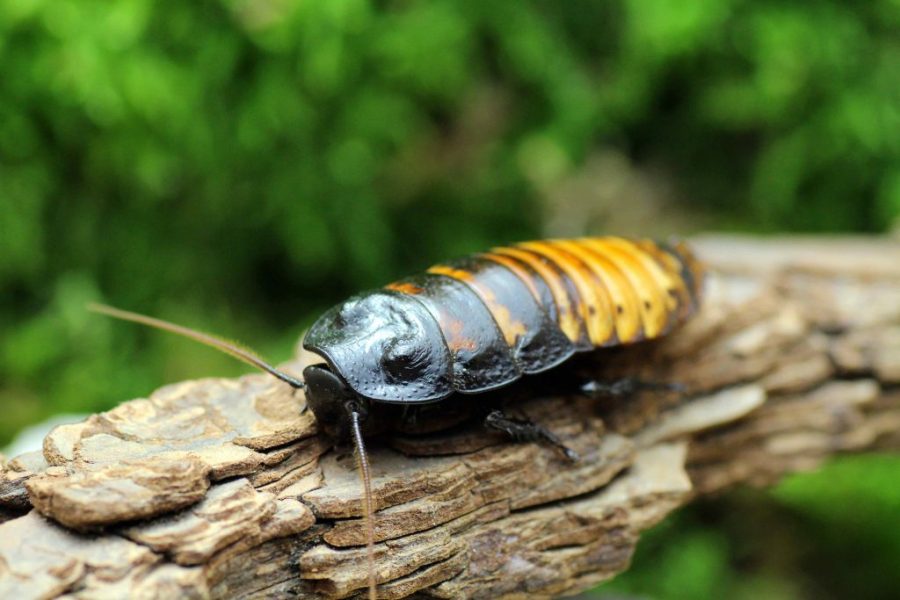
My MSci research project involves investigating hissing in the courtship displays of Giant Madagascan Hissing Cockroaches with the hope of shedding more light on sexual selection and evolution in this intriguing tropical insect species. This blog will tell you what my research involves, why it is important and the problems I have faced along the way without becoming too hiss-terical (I apologise for the awful pun).
Firstly, a bit of background:
Sexual selection is a branch of evolution which involves inter- and intrasexual selection. Intersexual selection describes members of one sex choosing members of the other based on certain characteristics, whereas intrasexual selection involves competition between members of the same sex for access to the other sex. In other words, it’s the unusual courtship displays and classic male fights that we’ve all watched on our beloved David Attenborough documentaries. Sexual selection drives the selection of many of the characteristics we see (and love) throughout nature. This includes traits associated with attracting a mate such as courtship displays and exaggerated visual characteristics (called ornaments), and traits associated with competing for mates such as weaponry (e.g. deer antlers) and aggressive displays. Throughout nature these characteristics are often found in males, for example male birds usually have fancy coloured feathers whereas females are usually browner and duller. But why is this?
Well, let me explain. One reason is that females are often what’s called the ‘limited resource’ because they (more often than not) invest more time and energy into reproduction. This leads to female choice, which describes females selecting males based on traits, signals or displays which are thought to signal male quality. Therefore, sexual selection drives the selection of male traits AND the selection of preferences in females, because it pays-off when a female selects a high-quality mate. So, male birds tend to be brightly coloured to attract females, and females are usually duller because they do all the choosing and don’t need to do the hard work (until it comes to raising offspring, of course). Just as coloured feathers are used as signals in birds, it is thought that hissing may be an important signal in hissing cockroaches. Through my research, I am investigating the signalling and courtship which exists in Giant Hissing Cockroaches as a result of sexual selection – which I hope you now appreciate is really interesting and exciting.
Watch this video to learn more about sexual selection:
My project:
I am studying Gromphadorhina portentosa (yes, it’s an absolute mouthful but you get used to it) which is one of the only species of insect that produces sound by forcing air through spiracles (a modified part of their respiratory system).
The distinctive hiss which gives them their (somewhat ominous) common name of Giant Madagascan Hissing Cockroaches is used by males during courtship displays and as an aggressive signal in competition. It is also used as an anti-predator signal by both sexes.
Compared to the aggressive hiss, there is very little known about hissing in a courtship context. I hope to change that.
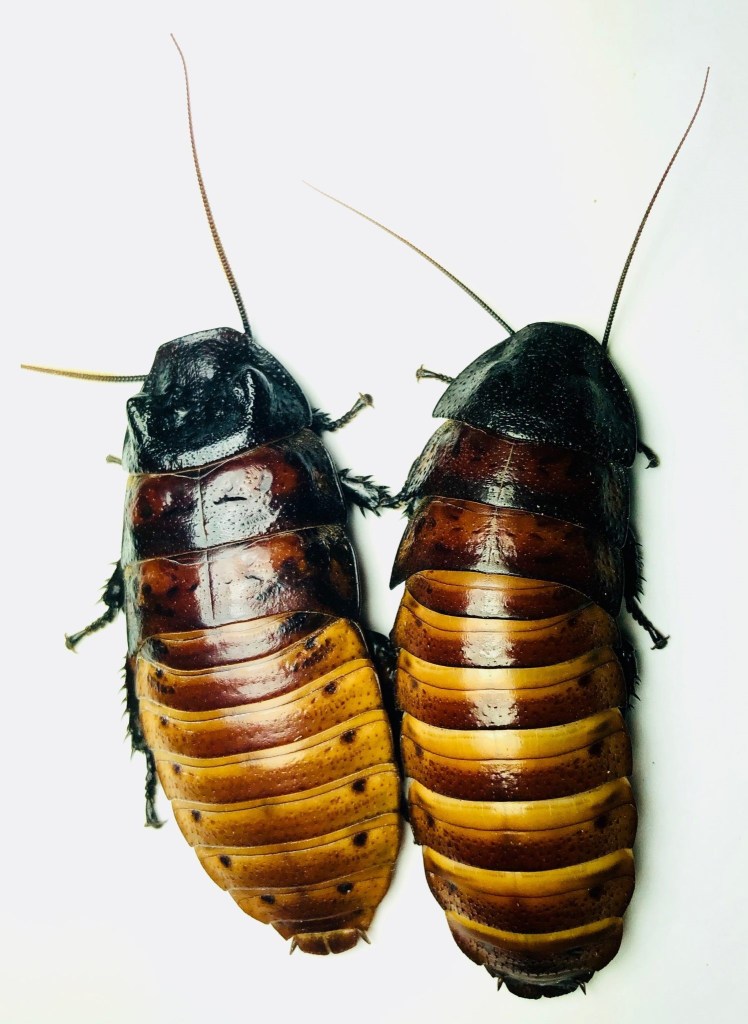
My project is divided into two parts:
- Observational study
- Experimental study
I have already completed the courtship observational trials which involved a number of steps:
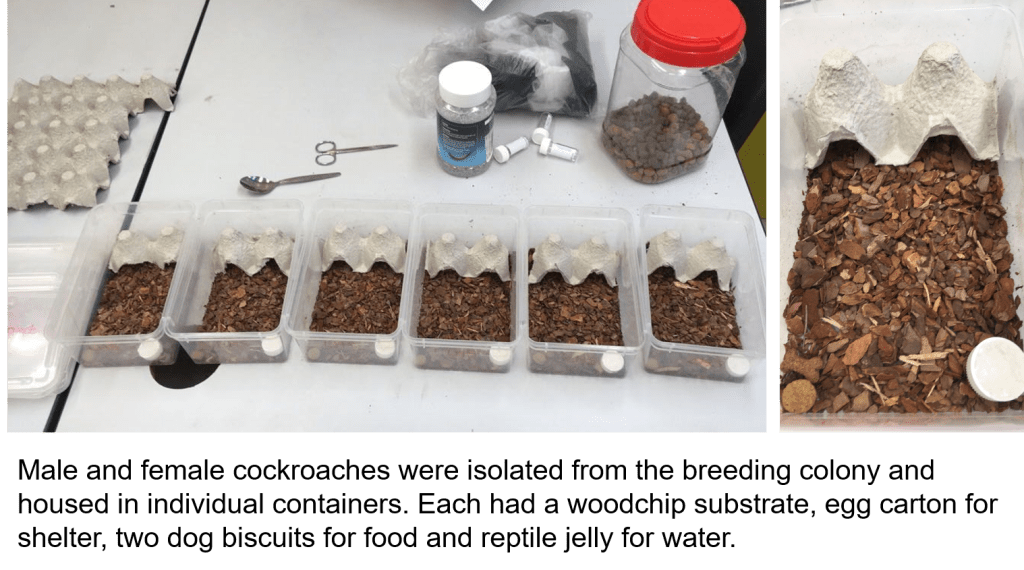
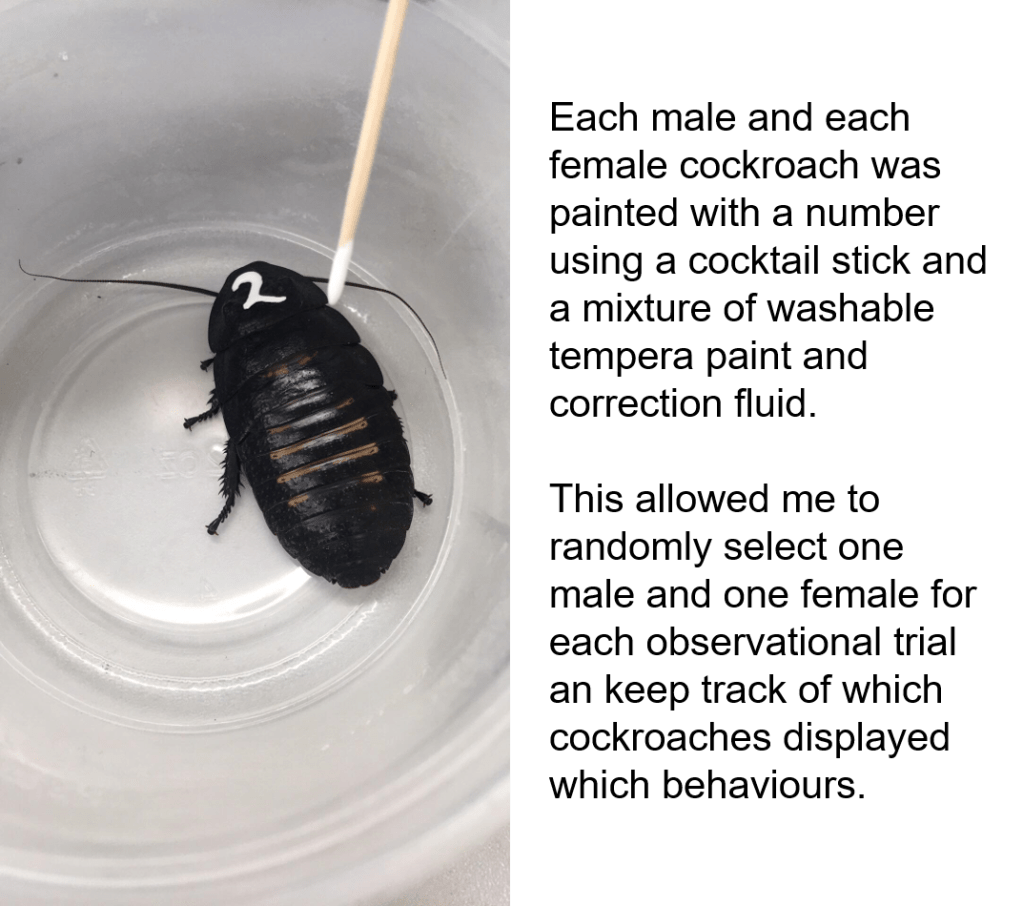
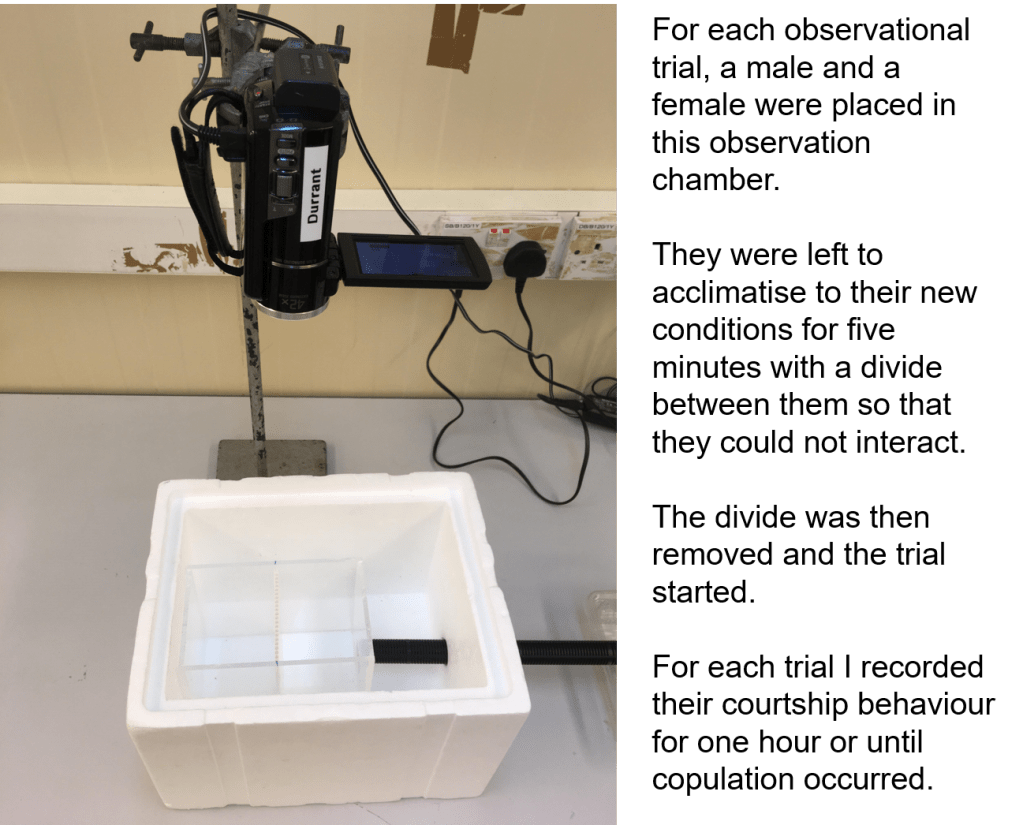
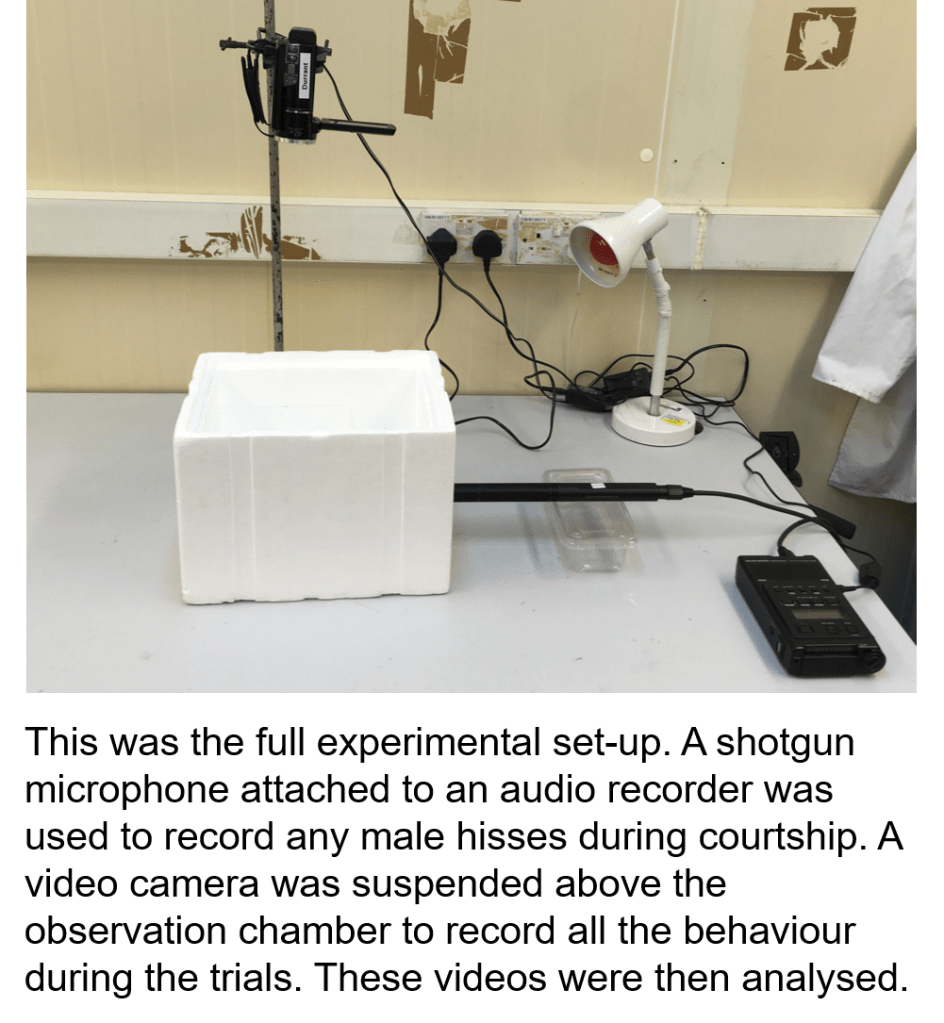
After completing the observational trials, I used an event-logging software called BORIS to analyse the courtship videos and generate the data I need to investigate courtship in this species. I will statistically analyse this data to determine if there are any patterns in the courtship display and hopefully reveal why hissing is important within courtship.
Unfortunately, I cannot now complete part 2 of my research project as a result of the university closure due to COVID-19. This would have involved playback trials in which I would observe female responses to male antagonistic hisses and courtship hisses (chosen at random each time). Using this data, I hoped to determine if females respond differently to the two types of hisses and hence shed more light on the role of hissing within courtship.
Why is this important?
- G. portentosa is one of the only species to hiss in the way it does, meaning that I have the opportunity to contribute something novel to this field of research (which as a scientist is always exciting).
- Tropical species such as this one are underrepresented in sexual selection research. By understanding these species better, we can understand different types of adaptation across a larger pool of species and this will strengthen our holistic understanding of sexual selection and evolution, which are fundamental to our understanding of the natural world.
- I hope that my research will be built on in the future to further determine the role of this distinctive courtship behaviour and deepen our understanding of sexual selection in this species.
Research is never plain sailing…
There have been a few problems along the way, the biggest of which being that animals don’t always behave how you expect them to. This resulted in days, even weeks of uncertainty about whether I would obtain any valuable data because the cockroaches weren’t interacting much during the observational trials. They do say not to work with children and animals, and I’m starting to understand why. However, this eventually resolved itself and I now have a dataset which I hope will produce some significant results.
My project has given me an insight into what life is like as a research scientist – there are ups and downs and a lot of uncertainty, but it is rewarding and exciting when things do go well. Now more than ever, I fully appreciate the words of Robert Burns; “The best laid plans of mice and men often go awry”. Expect, I guess for me it would be cockroaches instead of mice.
If you have any questions, about the science itself or about my research project, please comment below, I am more than happy to talk about it all.
Recommended reading:
- Augustyn. A., Bauer. P., Duignan. B., Eldridge. A., Gregersen. E., McKenna. A., et al. [n.d.] Courtship Behaviour. Encyclopaedia Britannica.
- Durrant, K.L., Skicko, I.M., Sturrock, C. & Mowles, S.L. (2016) Comparative morphological trade-offs between pre- and post-copulatory sexual selection in Giant hissing cockroaches (Tribe: Gromphadorhini). Scientific Reports 6, 36755; doi: 10.1038/srep36755.
- McGregor, P. K. (1992) Playback and Studies of Animal Communication. Springer Science & Business Media, New York.
- National Geographic. (2020) Madagascar Hissing Cockroach.
- Nelson, M.C. & Fraser, J. (1980) Sound production in the cockroach, Gromphadorhina portentosa: evidence for communication by hissing. Behavioural Ecology and Socio-biology 6, 305–314.
- Shuster, S. M. (2009) Sexual Selection and Mating Systems. Proceedings of the National Academy of Sciences of the United States of America 106 (Supplement 1), 10009–10016.
 Hopefully Mastering Science